The Role of Climate in Wine, Explained Simply


TL;DR:
Climate influences every aspect of wine, from grape ripeness to aroma, color, and body, beyond just sugar levels.
Extreme weather and phenological shifts caused by climate change can lead to vintage variation, crop loss, and altered grape chemistry, affecting wine quality.
Think the climate just makes grapes sweeter or more sour? That’s only scratching the surface. The role of climate in wine goes way deeper than sugar levels. Climate shapes everything from a wine’s color and aroma to its body, alcohol content, and even whether a vintage exists at all. This article breaks it all down in plain English, so you can walk into any wine shop, pick up a bottle, and actually understand why it tastes the way it does. No lab coat required.
Table of Contents
Key takeaways
Point | Details |
Climate does more than ripen grapes | Temperature, rainfall, and seasonal patterns together shape flavor, aroma, acidity, and body. |
Cool vs. warm climate wines taste different | Cool climates produce crisp, high-acid wines; warm climates lean toward richer, higher-alcohol styles. |
Phenology shifts change vintage outcomes | Earlier budbreak and flowering can compress ripening windows and throw off aromatic balance. |
Heat stress alters grape chemistry fast | Temperatures above 35°C can degrade color pigments and acids within days, changing a wine’s character. |
Extreme weather creates real production risks | Frost, drought, and heatwaves can wipe out significant portions of a vineyard’s annual crop. |
The role of climate in wine: temperature basics
Let’s start with the biggest lever: temperature. Not just the average temperature, but the highs, the lows, and that all-important swing between daytime and nighttime heat known as the diurnal range.
Grapes grown in cooler climates, think Burgundy, Germany’s Mosel, or New Zealand’s Marlborough, tend to retain more natural acidity. The slower ripening gives the fruit more time to develop complex aromatic compounds before sugar takes over. The result? Wines that are crisp, bright, and full of delicate floral or citrus notes.
Warm climate grapes ripen fast. Sugar accumulates quickly, acids drop, and you get bold, full-bodied wines with higher alcohol and ripe fruit flavors. Think Australian Shiraz or Napa Valley Cabernet. Higher temperatures raise sugar concentration while lowering acidity, pushing wines toward richer, honey-edged profiles.
Here is a quick breakdown of what to expect across climate types:
Climate type | Sugar/alcohol | Acidity | Typical aromas | Example regions |
Cool | Lower | High | Citrus, green apple, floral | Mosel, Burgundy, Marlborough |
Moderate | Balanced | Balanced | Stone fruit, red berries | Tuscany, Bordeaux, Willamette Valley |
Warm | Higher | Lower | Ripe berry, plum, honey | Napa Valley, Barossa, Rioja |
Winemakers and researchers use a metric called growing degree days (GDD) to measure how much heat accumulates during the growing season. It is basically a running total of warmth that helps predict ripening. Regions with high GDD tend to produce ripe, powerful wines. Regions with low GDD lean toward elegance and restraint.
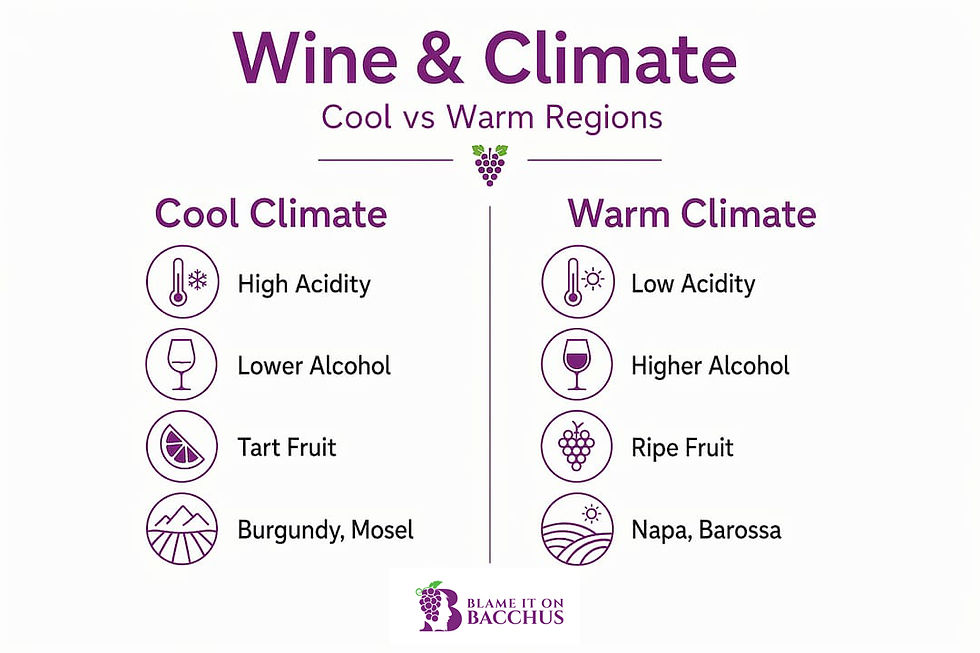
Pro Tip: When you see a wine labeled as coming from a cooler region, expect more tartness and lower alcohol. When the label says a warm region, brace yourself for a fuller, fruit-forward ride.
How phenology shifts mess with your wine
Phenology is just a fancy word for the timing of a plant’s life stages. Budbreak, flowering, veraison (when grapes change color and start ripening), and harvest. These stages happen in sequence, and they are sensitive to temperature.
Here is the kicker: as growing seasons warm up, these stages are happening earlier. Warming trends have advanced phenological stages by 11 to 13 days, accelerating sugar accumulation while reducing aromatic maturity under extreme heat. That means grapes are technically ripe on paper (lots of sugar) before their aromas have fully developed. You end up with a wine that is boozy but not very complex.
Here is how that chain of events plays out:
Earlier budbreak happens when spring warms up faster. This sounds like a good thing, but it exposes those young, tender shoots to late spring frosts that can kill the year’s crop before it even starts.
Compressed ripening windows mean grapes go from unripe to overripe faster, leaving growers with less time to react to sudden weather changes.
Earlier harvests coincide with the hottest part of summer in many regions, which means picking in brutal heat. That stresses the fruit and the winery team.
Aromatic loss is a real consequence. Climate change alters multiple interacting drivers rather than just making everything uniformly riper. Delicate floral and herbal notes that define certain varietals can fade before growers have a chance to pick.
This explains vintage variation. Two bottles of the same wine from different years can taste dramatically different. One cool, rainy summer in Bordeaux can produce a leaner, more structured wine. A hot, dry year? Big, extracted, and ready to drink young. Climate is the invisible author behind every vintage story.
Pro Tip: Pay attention to vintage charts for regions like Burgundy or Champagne where phenological timing matters enormously. A chart tells you what the growing season was like, which tells you what is in the glass.
Heat stress and what it does to grape chemistry
This is where things get genuinely fascinating. Grapes do not just passively bake in the sun. They respond to heat at a biochemical level, and those responses show up directly in the wine you drink.

Heat stress thresholds commonly occur around 32 to 35°C for leaves and 35 to 40°C for berries. Once those thresholds are crossed, photosynthesis slows down and the grape’s internal chemistry starts shifting in ways that are not always flattering.
Research on Pinot noir tells the story clearly. Heating Pinot noir bunches to 39°C over 7 days reduces malic acid and anthocyanins. Malic acid is one of the key acids that gives wine its refreshing tartness. Anthocyanins are the pigments responsible for red and purple color. Lose both, and your elegant cool-climate Pinot starts looking and tasting like a shadow of itself.
A few key effects of heat stress on grapes:
Color degrades. Anthocyanins break down under intense heat, leaving red wines looking brick-toned or pale before their time.
Acidity drops. Malic acid breaks down faster in heat, which is why warm-vintage wines can feel flat or flabby without careful winemaking intervention.
Aroma compounds suffer. Heat suppresses the development of terpenes and other fragrance-building molecules. The wine loses its “nose.”
Phenolic ripeness lags. Tannins (those compounds that create that dry, gripping sensation) may not ripen evenly alongside sugars, leaving wines tasting harsh.
“Phenolic plasticity is a core adaptive mechanism; vineyard microclimate management can actively steer phenolic outcomes to preserve wine quality under climate stress.” Abiotic Stress Effects on Phenolic Metabolism in Vitis vinifera
The good news is that smart growers fight back. Canopy architecture and irrigation timing can shield berries from the worst heat, preserving both color and freshness. Shade cloth, cover crops, and adjusting leaf removal are all tools in the modern grower’s kit.
Pro Tip: If a red wine you usually love tastes oddly flat or pale in a particular vintage, heat stress during that growing season is often the culprit. Check the vintage notes before writing off the producer.
When extreme weather wrecks the whole harvest
Beyond the day-to-day effects of temperature, wine growing conditions face a bigger threat: extreme weather events. Frosts, droughts, and heatwaves are not just inconveniences. They can wipe out entire harvests.
Here is why frost is particularly brutal in the current climate. Warmer springs trigger early budbreak. Young shoots emerge weeks ahead of schedule. Then a cold snap rolls in and those tender shoots freeze overnight. A 2026 frost event in New Jersey destroyed around 80% of vineyard crops across the state. One cold night, months of work gone.
Drought creates a different kind of problem. Higher temperatures increase productivity up to a point, but extreme heat combined with water stress pushes vines past their limits. Leaves shut down, berries shrivel, and yields collapse.
The effects ripple outward too. Reduced harvests mean lower supply. Lower supply drives up prices. That bottle you love may get harder to find or more expensive year after year. It is one of the most direct ways that effects of weather on wine land in your wallet.
Vineyards are adapting in real ways: planting heat-tolerant grape varieties, moving vineyards to higher elevations, installing wind machines to fight frost, and using moderate summer irrigation to relieve water stress without waterlogging the soil. It is an ongoing, creative fight against an increasingly unpredictable growing environment.
What this means for you as a wine drinker
All of this science is genuinely useful when you are standing in a wine aisle. Once you understand how climate affects wine quality, you can decode a lot just from the label.
Here are a few practical tips for putting climate knowledge to work:
Look at the region first. A Riesling from Germany’s Mosel is a completely different animal from one grown in Australia’s Clare Valley. Same grape, wildly different climate, wildly different wine.
Check the alcohol level. High alcohol (14.5% and above) usually signals a warm climate or a warm vintage. Lower alcohol (12% or below) often means cool conditions and higher natural acidity.
Expect vintage variation. If your favorite Burgundy tastes different this year, that is climate talking. It is not a flaw. It is a feature. Check a beginner’s guide to white wine varieties to learn which styles are most sensitive to yearly shifts.
Use climate to guide food pairings. Crisp, cool-climate whites pair beautifully with lighter dishes like seafood and salads. Warm-climate reds, with their richer body, stand up to bold, meaty flavors.
Explore different regions intentionally. Taste a Pinot Noir from Oregon next to one from Burgundy next to one from California. Same grape, three climates, three personalities. This is how grape varietals unlock flavor in ways a textbook never could.
Understanding the vineyard climate considerations behind your favorite wine transforms casual sipping into something genuinely rewarding.
My honest take on climate and wine complexity
I’ve tasted a lot of wines over the years, and the one thing I keep coming back to is how often climate gets oversimplified. You hear “warm climate equals bold wine” and “cool climate equals delicate wine,” and sure, that is a useful starting point. But I’ve had steely, mineral-driven whites from surprisingly warm pockets of Spain, and rich, opulent reds from cooler vintages in Burgundy that defied every expectation.
What I’ve learned is that climate is not a dial. It is more like a conversation between the weather, the soil, the grape variety, and the people growing it. A grower who understands their microclimate, who adjusts canopy density, picks at the right moment, and responds to each season creatively, can make a great wine even in a tough year.
I also think the anxiety around climate change and wine can sometimes overshadow the good news: winemakers are more adaptable than people give them credit for. Are some classic regions under genuine pressure? Yes. But new regions are emerging. High-elevation vineyards are producing thrilling wines. The map of great wine is actually expanding even as parts of it shift.
My advice is to stay curious. Every bottle you open is a snapshot of one place, one season, one set of growing conditions. That is remarkable when you think about it.
— Thomas
Deepen your wine knowledge with Blameitonbacchus

Understanding climate is just one piece of the wine puzzle, and it is a genuinely fun one once you get going. At Blameitonbacchus, we have made it our mission to make wine education feel less like homework and more like happy hour. Whether you want to explore how climate zones for wine production shape your favorite bottles or just want to drink more confidently, our wine courses walk you through it all in a totally beginner-friendly way. Prefer something more personal? Check out our private classes for a one-on-one experience tailored to exactly what you want to learn. Plus, our full wine education hub has resources to keep you exploring long after you finish this article.
FAQ
What is the role of climate in wine production?
Climate shapes grape ripeness, acidity, color, aroma, and body by controlling temperature ranges, rainfall patterns, and seasonal timing throughout the growing season.
How do cool and warm climates produce different wines?
Cool climates yield wines with higher acidity and lower alcohol, while warm climates produce fuller-bodied wines with ripe fruit flavors and higher alcohol levels.
How does heat stress affect grapes and wine quality?
Temperatures above 35°C can reduce malic acid and degrade color pigments in grapes, resulting in wines with lower acidity, duller color, and less aromatic complexity.
Why do wines from the same producer taste different each year?
Vintage variation is caused by year-to-year shifts in growing season weather, including temperature swings, rainfall, and frost events that alter how grapes develop.
Can extreme weather destroy a vineyard’s entire harvest?
Yes. Frost events following early budbreak triggered by warmer springs can destroy up to 80% of a crop in a single night, as seen in New Jersey’s 2026 growing season.
Recommended
Comments