How to Conduct Wine Flights at Home: A Beginner's Guide


A wine flight is a curated series of small pours served side by side so you can compare, contrast, and actually learn something. To run one successfully, you need a clear theme, 3–5 wines served in a logical order, consistent 1–2 oz pours, and a tasting sheet for each guest. That’s it. The rest is just fun.
Here’s your quick-start checklist before we dig into the details:
Pick a theme (one grape variety, one region, or one style progression)
Choose 3–5 wines and arrange them from lightest to fullest
Pour consistently at 1–2 oz per wine per guest
Set out tasting sheets so guests can jot notes and scores
Reveal labels at the end for a satisfying “aha” moment
Pro Tip: Curate the selection yourself rather than letting guests randomly bring bottles. Random additions break the theme and muddy the comparisons you worked hard to set up.
Table of Contents
What types of wine flights should you choose from?
Not all flights are built the same, and picking the right format is half the battle. Each type has a different learning objective, so match the format to your crowd.
Horizontal flight
A horizontal flight compares multiple wines from the same vintage but different producers or regions. Think three Pinot Noirs from California, Oregon, and Burgundy, all from the same year. This is perfect for curious beginners who want to see how terroir shapes a grape.

Vertical flight
Here you pour the same wine from the same producer across multiple vintages. A vertical Cabernet Sauvignon from 2018, 2020, and 2022 shows guests how a wine evolves with age. It’s a crowd-pleaser at dinner parties where at least a few guests already know their stuff.
Varietal flight
One grape, multiple expressions. A Chardonnay flight might include an unoaked Chablis-style, a lightly oaked California version, and a big buttery one. Beginners love this because it proves that the same grape can taste wildly different depending on how it’s made.
Regional tour
Pick a country or region and travel through it glass by glass. A Spanish flight could move from a crisp Albariño to a Tempranillo Rosado to a bold Rioja Reserva. This format works beautifully for themed dinner parties.
Style-based progression
Light to full, dry to sweet. This is the most beginner-friendly format because the progression feels intuitive. Start with a sparkling wine, move through whites and rosé, land on a red, and finish with a dessert wine if you’re feeling adventurous.
Pro Tip: For your very first flight, go varietal. One grape, three expressions. It keeps the conversation focused and gives guests an instant “I get it now” moment.
How do you taste each wine in a flight?
The 5 S’s are the professional tasting sequence: See, Swirl, Smell, Sip, Savor. Walk every guest through them for each pour and the whole event clicks into place.
See — Hold the glass against a white background (a napkin works). Note the color depth and hue. A pale straw versus a deep gold tells you something before you even smell it.
Swirl — Swirl gently for 10–15 seconds to release aromatic compounds. Don’t be shy about it.
Smell — Nose the glass before you sip. Take two short sniffs, then one long one. Ask yourself: fruit, earth, oak, or something else?
Sip — Let the wine coat your whole palate. Notice acidity (does it make you salivate?), tannin (that drying sensation on your gums), body (light like water or heavy like cream?), and sweetness.
Savor — After you swallow (or spit), count how long the flavor lingers. A finish that lasts 20–30 seconds is a sign of quality.
For quick note-taking, prompt guests with four fields: appearance, primary aromas, palate feel, and finish length. A simple 1–10 score at the end rounds it out. You’ll find a full printable layout in the templates section below.
Pro Tip: Keep pours at 1–2 oz per wine. That’s plenty for all five steps without overwhelming anyone’s palate by wine three. Pours in that range give tasters enough liquid for the full sequence while keeping total alcohol manageable across the flight.
How do you plan and select wines for a flight?
Start with the theme, and let everything else follow from it. A focused theme is the single factor that separates a random drinking session from something genuinely educational. When guests have a frame of reference, every sip teaches them something.

How many wines is the right number?
Three to five wines is the sweet spot for home flights. Three feels tight and focused. Five gives you room to build a real arc. Go beyond five and attention starts to drift, especially after glass three. For casual groups, a moderate number of wines at small pours works well; larger groups tend to do better with slightly more wines at smaller pours.
Ordering the wines
Always move from light to full: sparkling first, then lighter whites, fuller whites or rosé, light reds, bolder reds, and dessert or fortified wines last. Starting with a big tannic red would numb your palate for everything that follows.
Budgeting and sourcing
You don’t need expensive bottles to run a great flight. Mid-range wines often show more interesting variation than trophy bottles. For a 4-wine flight with 8 guests at 1.5 oz pours, you’ll need roughly two bottles per wine. Single-serve bottles (usually 187 ml or 375 ml) are a smart option for smaller gatherings because they eliminate the waste of opening six full bottles and only using a third of each.
Pro Tip: Call your local wine shop and tell them your theme and budget. A good shop will pull a flight-ready selection in ten minutes. They do this all the time.
What’s the practical setup for running a wine flight?
Good logistics are invisible. Bad logistics are all anyone remembers. Get these details right and the tasting runs itself.

Glassware
Use ISO 3591:1977-style tulip glasses if you have them. Their inward-curving rim concentrates aromas right where your nose goes. More important than the brand or style, though, is consistency: every guest should have identical glasses across the flight. Different shapes create different aromatic experiences, which skews comparisons.
Serving temperatures and decanting
Wine Category | Serving Temperature | Decanting? |
Sparkling / Champagne | — | No |
Light whites (Pinot Grigio, Sauvignon Blanc) | — | No |
Full whites (oaked Chardonnay, Viognier) | — | Optional (15 min) |
Rosé | — | No |
Light reds (Pinot Noir, Gamay) | — | Optional (20 min) |
Full reds (Cabernet, Syrah, Barolo) | — | Yes (30 min) |
Dessert / Fortified | — | No |
Pour sizes and bottle math
Using standard pours, each 750 ml bottle yields multiple pours. The total bottles needed depends on the number of wines, guests, and pour size.
Host timeline
1 hour before: Pull reds from the cellar, chill whites and sparkling, set glasses, print tasting sheets.
30 minutes before: Decant any full reds, set out palate cleansers and water.
As guests arrive: Pour a welcome sparkling or water while you explain the theme.
Tasting rounds: Allow roughly 5–7 minutes per wine.
Reveal: Flip the labels or announce the wines at the end.
Pro Tip: Between wines with strong oak or high tannin, rinse glasses with a small splash of the next wine (called a “wine rinse”) rather than water. Water can leave a film that mutes the next wine’s aromas.
How do you lead and present a wine flight?
You don’t need to be a sommelier to host well. You need a short opening, a consistent rhythm, and a few tricks for keeping the conversation lively.
Your opening script (3–5 minutes)
Welcome everyone, then cover three things:
The theme: “Tonight we’re tasting three Pinot Noirs from three different American regions to see how much place matters.”
The format: “We’ll go through each wine using the 5 S’s. I’ll guide you. There are no wrong answers.”
The tasting sheet: “Jot down whatever you notice. A score out of 10 at the bottom. Labels stay hidden until the end.”
That’s all you need. Keep it under five minutes and get the wine in the glass.
The per-wine flow
Pour all guests simultaneously (same amount, same glass position).
Walk through See, Swirl, Smell together before anyone sips.
Open the floor: “What’s the first aroma that hits you?”
Let everyone sip and fill in their notes for 2–3 minutes.
Ask one comparison prompt: “How does this feel compared to the last one? Heavier? More acidic?”
Collect scores before moving on.
Managing mixed-knowledge guests
This is where most home flights go sideways. The wine expert in the corner starts rattling off tasting notes in French and the beginners shut down. Alternate between content-driven prompts (“name one aroma you didn’t expect”) and open discussion to keep experts engaged without letting them dominate. If someone goes deep on a technical point, validate it briefly and redirect: “Great catch on the brett — does anyone else get something earthy?” You can also check out this beginner’s tasting guide for more prompts that work across experience levels.
Seat quieter guests next to you so you can draw them in with a direct question.
Avoid “right or wrong” language. Every observation is valid.
Use the scoring sheet as an equalizer: everyone has an opinion, and a number is easy to share.
What food pairings and palate cleansers work best for flights?
Food is a supporting actor here, not the star. The goal is to cleanse the palate between pours, not to create a full dinner.
Neutral palate cleansers
These reset your palate without leaving flavors that compete with the next wine:
Plain water crackers or unsalted bread — the gold standard
Still water — sip between every wine, not just when you feel like it
Plain white rice — underrated and surprisingly effective
Mild fresh mozzarella — works well between whites
Avoid anything heavily spiced, smoked, or sweet between pours. Those flavors linger and color your perception of the next wine.
Intentional pairings by category
You can also lean into a few deliberate pairings to illustrate wine-pairing principles. For a fuller guide to pairing wine with food, the logic is always the same: match weight with weight and contrast richness with acidity.
Light whites: fresh goat cheese, cucumber slices, or mild seafood
Full whites: aged Gruyère, roasted chicken, or buttered popcorn (seriously)
Light reds: charcuterie, mushroom crostini, or mild hard cheese
Bold reds: dark chocolate, aged cheddar, or a simple beef slider
For a fun Mediterranean angle, tapas-style small plates pair beautifully with a Spanish or Southern French regional flight.
Allergy and dietary notes
Always ask guests about allergies before you plan the food spread. Sulfite sensitivity is common among wine drinkers and worth acknowledging. Keep dairy and nut-based items clearly labeled on shared platters. A simple index card next to each dish does the job.
Pro Tip: Set out the palate cleansers before the first pour, not after. Guests who start snacking on flavored chips before wine one will have a harder time tasting clearly all night.
How do you run a virtual wine flight?
Remote flights are genuinely fun when the logistics are sorted. The key is getting the same wines into everyone’s hands before the session starts.
Getting wine to guests
Coordinated purchase list: Share a shopping list 5–7 days ahead. Include the exact bottle names, sizes, and where to buy locally or online.
Single-serve bottles: 187 ml splits are widely available for sparkling and some whites. They’re perfect for mailing or dropping off because no one has to open a full bottle alone.
Local pick-up: If guests are in the same city, arrange a group order from one shop and have everyone pick up their set.
Platform and timing tips
Zoom, Google Meet, or any video platform works. Keep the guest list under 12 for a manageable conversation. Mute everyone during the See, Swirl, Smell steps so the host can guide without crosstalk. Build in a 10-minute buffer at the start for tech issues and late arrivals.
Adapting the script for remote
Send the tasting sheet as a PDF the day before so guests can print it. Use a shared Google Doc or a simple poll (Mentimeter works well) for live scoring so everyone can see results in real time. The reveal moment lands especially well on video because you can watch everyone’s reactions at once.
Pro Tip: Ask guests to have their bottles chilled or at the right temperature before the call. Send a temperature reminder with the shopping list. Nothing kills a virtual flight faster than someone’s red being ice-cold because they forgot to pull it out of the fridge.
Common wine flight rules: what’s real and what’s myth?
A few “rules” float around the wine world that are worth knowing, even if you don’t follow all of them.
How many glasses are in a flight?
A typical flight runs 3–5 wines at 1–2 oz each. Total liquid across the flight is roughly equivalent to 1–3 standard 5 oz glasses of wine, depending on pour size and number of wines. So no, a 5-wine flight isn’t five glasses of wine. It’s closer to one and a half.
What is the 75-85-95 rule?
This refers to serving temperatures for wine: whites around 75°F are too warm, 45–55°F is the practical sweet spot, and reds served above 65°F lose their freshness. The numbers vary by source, but the principle is consistent: most Americans serve red wine too warm, and white wine too cold. Pull your reds out of a 65°F room-temperature environment and chill them slightly; pull your whites out of the fridge 15–20 minutes before serving.
What is the 20-minute rule?
Give full-bodied reds about 20 minutes of air before the first pour. This is a simplified version of decanting advice. It won’t replace a proper 45-minute decant for a young Barolo, but for most table reds it softens tannins enough to make a real difference.
Glass cleaning between wines
Rinse glasses with still water between pours if you’re reusing them. For wines with strong oak, high tannin, or residual sweetness, a quick wine rinse (a splash of the next wine swirled and discarded) is more effective than water alone. Residual aromas from a heavily oaked Chardonnay will absolutely color your perception of the next wine if you skip this step.
Safety reminder
A 5-wine flight at 1.5 oz pours totals about 7.5 oz of wine, roughly 1.5 standard drinks. That’s manageable, but pace it over 90 minutes and keep water on the table. Spitting into a spittoon is completely normal and smart for longer tastings. Make sure no one drives home after a flight without a plan.
Ready-to-use flight templates and tasting note layout
Here are three plug-and-play flight menus you can run tonight, plus a tasting note template to print for guests.
Sample flight menus
Flight Name | Wines (in order) | Pour Size | Bottles Needed (8 guests) |
American Pinot Noir Tour | Willamette Valley OR → Sonoma Coast CA → Santa Barbara CA | 1.5 oz each | 2 per wine (6 total) |
Chardonnay Spectrum | Unoaked Chablis-style → Lightly oaked CA → Heavily oaked CA | 1.5 oz each | 2 per wine (6 total) |
Light-to-Full Red Progression | Pinot Noir → Merlot → Cabernet Sauvignon | 2 oz each | 3 per wine (9 total) |
Printable tasting note template
Copy this layout onto a card or sheet for each guest:
Host checklist for the night of
[ ] Bottles at correct temperature 30 min before guests arrive
[ ] Identical glasses set per guest (one per wine, or one rinsed between pours)
[ ] Tasting sheets and pens at each seat
[ ] Water and palate cleansers on the table
[ ] Labels covered or bottles wrapped if doing a blind tasting
[ ] Decanted reds opened and breathing
[ ] Reveal moment planned (announce wines after everyone scores the last pour)
Key Takeaways
A great wine flight comes down to one decision: curate with intention, and everything else follows naturally.
Point | Details |
Theme is everything | A single focused theme (varietal, regional, or style) turns casual sipping into a real learning experience. |
Stick to 3–5 wines | Three to five wines is the sweet spot; beyond five, attention and palate both start to fade. |
Pour 1–2 oz per wine | Small pours let guests complete the 5 S’s without overloading their palate or their evening. |
Use identical glasses | Matching glassware across the flight removes shape-based bias and keeps comparisons fair. |
Blameitonbacchus for beginners | Blameitonbacchus’s online beginner classes give hosts a ready-made script, tasting framework, and the confidence to lead their first flight. |
Why beginner-first flights are the ones people actually remember
Here’s an opinion that might ruffle a few feathers in serious wine circles: the most technically perfect flight is not always the most memorable one. I’ve seen beautifully curated vertical tastings of Grand Cru Burgundy fall flat because the host spent more time lecturing than listening. Meanwhile, a simple three-wine Chardonnay comparison with a curious group of total beginners can generate the kind of animated conversation that lasts until midnight.
The demand for curated tasting experiences has grown sharply in recent years, and the reason isn’t that people suddenly want to become sommeliers. They want to feel something. They want the “oh, that’s what tannin means” moment. They want to disagree with their friend about which wine is better and feel like their opinion counts.
That’s why the beginner-first framing matters so much. When you design a flight around discovery rather than demonstration, you give every guest permission to be wrong, to be surprised, and to learn out loud. The 5 S’s aren’t a performance. They’re a shared language that levels the playing field between the person who’s been drinking wine for 30 years and the person who just graduated from beer.
The hosts who get this right aren’t the ones with the most impressive cellar. They’re the ones who ask better questions.
Blameitonbacchus makes your first wine flight easier to host
Running a wine flight for the first time feels like a lot until you realize you already have everything you need in this guide. But if you want to go from “I think I can do this” to “I’ve got this completely,” Blameitonbacchus’s online beginner wine classes are built exactly for this moment.
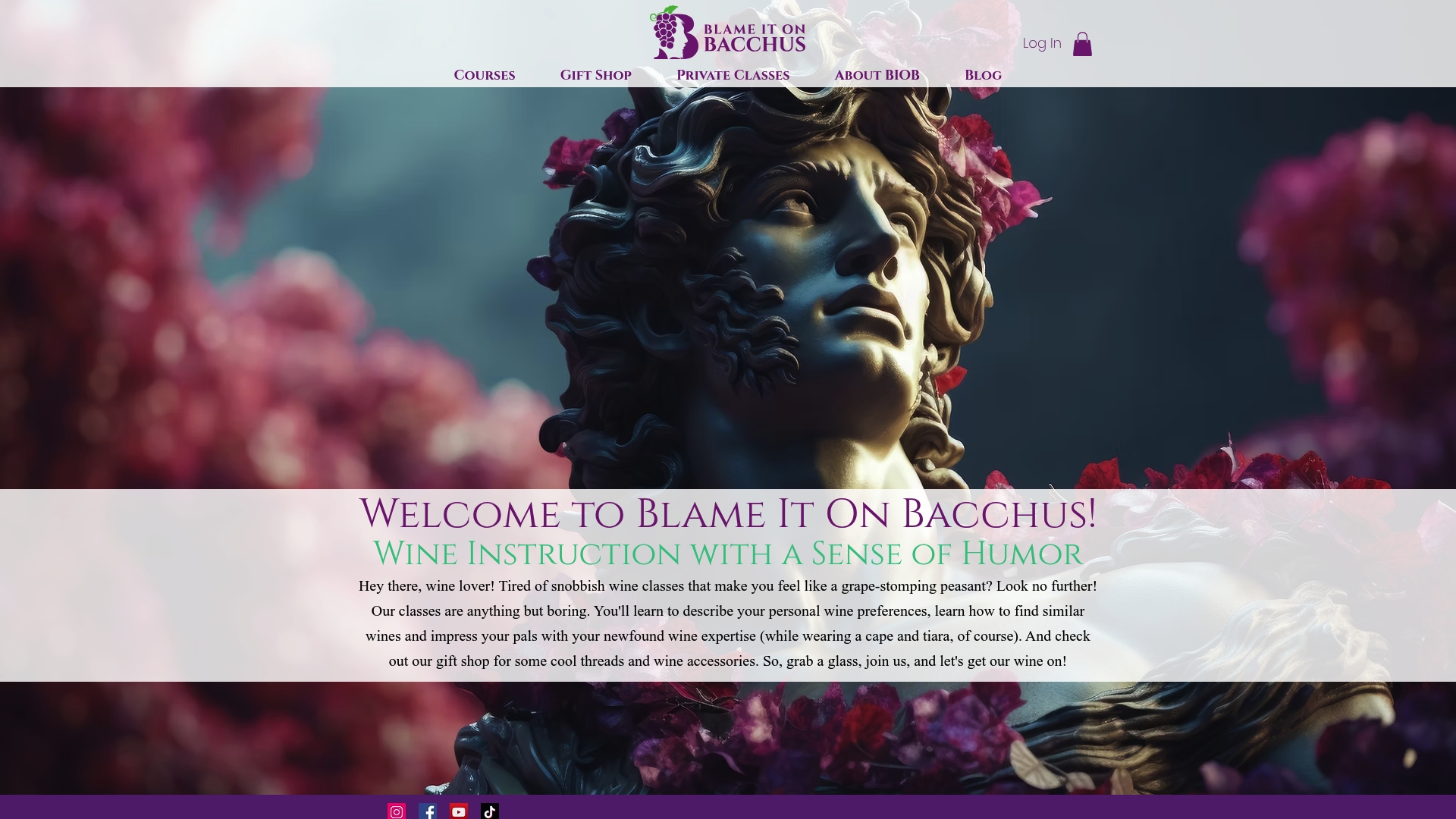
The classes walk you through tasting technique, wine categories, and food pairing in plain language, with no prior knowledge required. You get a structured framework you can apply directly to your next flight, plus the vocabulary to actually lead the conversation with confidence.
Learn the 5 S’s with guided practice, not just a definition
Understand how to sequence wines and explain why the order matters
Build enough wine vocabulary to keep any group engaged
Get the foundation to host flights that guests talk about afterward
And while you’re at it, grab some wine-themed gear to set the mood. Nothing says “we’re doing this properly” like showing up in a great wine tee. Head to the Elements of Wine class and start learning today.
Useful sources
These are the resources that shaped this guide. Each one is worth bookmarking if you want to go deeper on a specific topic.
Wine Flight Guide: How to Order, Taste & Enjoy Wine Flights Like a Pro — Nicole Takes Flight: A practical breakdown of flight ordering, tasting steps, and what to look for in a well-built flight.
How to Host a Wine Tasting at Home — WineFullLiving: Strong guidance on theme selection and why it matters for learning.
Wine Tasting Party Tips — Food & Wine: The case for curating your own flight rather than letting guests bring random bottles.
How to Host a Wine Flight at Home — Usual Wines: Practical advice on single-serve sourcing and the 3–5 wine sweet spot.
What Is a Wine Flight? — Silver Oak Cellars: Authoritative take on total alcohol per flight and the role of spittoons.
Blameitonbacchus Wine Basics — Blameitonbacchus: The brand’s foundational wine content hub for readers who want to keep learning after their first flight.
FAQ
How do you do a wine flight?
Choose 3–5 wines around a single theme, arrange them from lightest to fullest, pour 1–2 oz per wine, and walk guests through the 5 S’s (See, Swirl, Smell, Sip, Savor) for each pour. Reveal the labels at the end for maximum discussion.
What is the 75-85-95 rule for wine?
The rule refers to serving temperatures: most Americans serve red wine too warm (above 65°F) and white wine too cold (below 45°F). The practical takeaway is to chill your reds slightly and let your whites warm up for 15–20 minutes before pouring.
How many glasses of wine is a wine flight?
A typical flight of 3–5 wines at 1–2 oz pours totals roughly 1–3 standard 5 oz glasses worth of wine per person, depending on pour size and number of wines.
What is the 20-minute rule for wine?
The 20-minute rule suggests giving full-bodied red wines about 20 minutes of air before the first pour. It’s a simplified decanting guideline that softens tannins and opens up aromas without requiring a full decanter setup.
Recommended
Comments